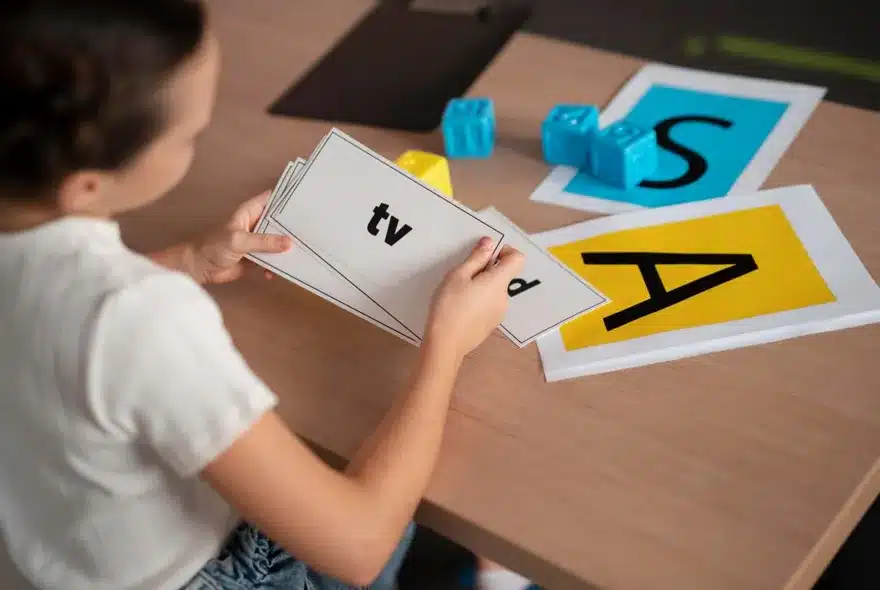
Ask 10 parents about the difference between “dyslexia screening” and a “dyslexia test,” and the answers will be the same. They will explain the same thing twice. Both terms appear the same across parents’ forums, school newsletters, and casual conversations with teachers. This is fine since both involve a child, a reading-based task, and an outcome.
Practically, they aren’t the same tool, and they don’t even operate the same way. A screening is an immediate, low-stakes check for risk. A comprehensive assessment includes a detailed multi-hour process built to confirm or even rule out an actual screening.
Confusing them both are two sides of a coin. Parents who panic over a screening outcome that never appeared conclusive, and parents assuming a diagnosis is enough whenever a formal diagnosis is required.
A study mentioned in the Journal of Dyslexia validates a widely used adult screening checklist. It found that it accurately identified real cases of dyslexia between 76% and 92%, following a similar array of rules to rule out dyslexia. Such numbers are truly effective for a quick tool. However, they also report a common share of results that fall into the gray zone, which only a complete dyslexia test can resolve.
Quick Definitions Before Going Further
Before you compare the two side by side, it can help to define each term clearly without conflating the real cause of the confusion.
A dyslexia evaluation is a short, affordable assessment that flags whether a child will show early risk indicators. This takes around a couple of minutes to an hour. It never screens anything independently. Simply categorizes children into “likely fine for now” and “worth a closer look.”
A dyslexia test, or a comprehensive assessment, involves a multi-hour, multi-domain evaluation administered by a trained specialist. It’s typically designed to confirm a screening, rule out other explanations, and produce a report with specific recommendations.
Comparison at a Glance
| Dyslexia Screening | Dyslexia Test (Full Evaluation) | |
| Purpose | Identification of actual problems and segmentation of the child according to the checks required | Verifies condition or eliminates genuine screening |
| Length | Usually done within 10 to 60 minutes | Take more than 3 hours but less than 6 hours each time |
| Administered by | Educators, assistants, or brief online tools | Professionals in psychological fields or specialists |
| Depth | One of two typical measures | Multiple domains such as phonology, reading, memory, and cognition |
| Output | Pass or fail or risk-level indicators | Detailed written report with scores or suggestions |
| Cost | The resource is often free or low-cost and, at times, universal, making it available to everyone | Higher cost, though public schools should provide it at no charge if warranted |
| Legal weight | Not enough on its own to get formal accommodations | Has the potential to help with IEP 504 Plan eligibility |
| Follow-up | A referral for further testing is commonplace | Creates an autonomous and implementable coverage |
What a Dyslexia Screening Actually Involves
Diagnosis typically answers a single question. Does this child show sufficient early warning signs justifying a closer insight?
The Purpose Behind Screening
Screenings are designed to assess the condition, not to focus on precision. Schools implement them to assess a broader group of children, detecting potential risk factors without the time or cost of a comprehensive assessment for each student. The objective here is risk sensitivity, not certainty over screening.
Who Typically Runs a Screening
Since screenings are short and standardized, they do not require the same level of specialized training as a complete assessment.
Those involved:
- Classroom teachers implementing state-approved tools
- School reading experts during routine inspections
- Pediatricians implementing short checklists at wellness visits
- Parents implementing validated checklists or short online tools
What Screening Can and Cannot Tell You
Results of a diagnosis are never a verdict, and treating it as either more or less than that leads to two different mistakes.
Screening detects:
- flag s typical risks based on a couple of primary signs
- Prompts the right type of referral for future assessments
- Fails to confirm a diagnosis independently
- Never rule out dyslexia with complete confidence in either way
A “passing” diagnosis never guarantees a child is clear. “Failing” one never guarantees a comprehensive screening. In either outcome, it directs us to the next step.
Common Screening Formats
Screening tools differ slightly depending on the setting, age group, and who’s administering them.
Screening includes:
- Short phonological awareness checklists
- Prompt letter-naming and sound-alignment tasks
- Parent or teacher questionnaires regarding behavior
- Short computer-based risk-assessment programs
What a Dyslexia Test Actually Involves
A comprehensive assessment can answer many more specific, consequential questions. Does this specific child align with dyslexia screening, and if so, what does the profile appear like?
The Purpose Behind Formal Testing
Instead of sorting children into broader risk categories, a comprehensive assessment creates individualized profiles across multiple domains: reading precision, phonological processing, rapid naming, spelling, and broader cognitive skills. Each compares against expected norms for a child of that age.
Who Administers a Full Evaluation
Since the stakes and challenges are high, formal testing requires specific credentials that screening tools do not.
Who undertakes the tests?
- Licensed psychologists across private or clinical practice
- School psychologists conducting in-district assessments
- Neuropsychologists for challenging or overlapping cases
- Speech-language pathologists for related language components
What Full Testing Adds Beyond Screening
The gap between them is more than just the length. It’s regarding certainty and depth.
This will:
- Confirm or rule out a definitive diagnosis
- Differentiating dyslexia from similar conditions
- Identifying specific strengths and weaknesses thoroughly
- Generating documentation supporting school accommodations
This amount of detail is important besides the diagnosis. A report that specifies this reveals exactly where phonological or processing gaps stand. It’s also specific enough to guide the next move, including whether a structured, evidence-based approach on platforms such as The Reading Guru fits into a child’s specific profile.
When Formal Testing Becomes Necessary
Specific conditions require a comprehensive assessment, regardless of what the diagnosis reveals or whether there was prior screening.
Situations include:
- A screening result that flags a meaningful risk
- Reading challenges persist irrespective of classroom support
- A family needs documentation for school accommodations
- Parents recognize signs of a screening tool that wasn’t designed to detect
Choosing the Right Starting Point for Your Child
Decisions about where to start largely depend on the level of concern and the amount of documentation a family typically requires.
Support is required when:
- When concerns are mild or only evolving
Here, a screening will work without any pressure initially.
- When screening already flags risk
Moving towards a comprehensive assessment rather than frequent screenings.
- When concerns are significant
Considering skipping right to a complete assessment instead of waiting on the screening results.
- When school accommodations become an objective
A comprehensive assessment is required, as screening alone never meets this level of documentation.
Conclusion
Most families never master the difference between the two tools, learning it only after already being concerned about a child who’s struggling. That’s the effective way to land here, and it never leaves anyone behind. What matters here is the decision that’s made from this point on.
So, choose the next step that matches the level of concern already present, rather than defaulting to whichever option feels less intimidating at the moment. That one choice shapes how soon a family gathers the real answer and how much unwanted waiting remains between them and it.