High Dynamic Range, or HDR, represents the most significant leap in video fidelity since the transition from standard definition to high definition. While 4K resolution increased the number of pixels on the screen, HDR improved the quality of those pixels, allowing for brighter highlights, deeper shadows, and a vastly wider array of colors. However, viewing HDR content requires display hardware capable of reproducing these extreme ends of the spectrum. In the world of projection, traditional lamp and single-laser units often struggle to do justice to the format. This is where triple-laser technology has emerged as a game-changer, fundamentally altering how we experience cinema in the home.
The Evolution From Standard Dynamic Range
To appreciate the impact of triple-laser engines, it is necessary to understand what HDR asks of a display. Standards like HDR10 and Dolby Vision are not merely about making the image brighter; they are about expanding the dynamic range to mirror what the human eye sees in the real world. A standard lamp projector is often limited by its light source. To achieve high brightness, it sacrifices color accuracy, or to achieve deep color, it sacrifices brightness. This trade-off compresses the dynamic range, resulting in an image that looks flat compared to the source material.
Triple-laser projectors, which utilize discrete red, green, and blue lasers, bypass these traditional limitations. By generating light at specific wavelengths, they can achieve high luminance without washing out the image. This capability is crucial for properly displaying the metadata found in HDR content, which tells the display exactly how bright a specific highlight—like a reflection on a chrome bumper or a star in the night sky—should be relative to the rest of the scene.
Color Volume: The Missing Link in Cinematic Realism
One of the most overlooked aspects of HDR performance is color volume. Color volume is the measure of a display’s ability to reproduce accurate colors at different brightness levels. Many displays can show a vibrant red in a dark scene, but as the brightness increases, that red tends to fade into pink or white. This is a common failure point for traditional projectors.
Triple-laser architecture excels here because of the spectral purity of the RGB light source. These projectors can maintain saturation even at peak brightness levels. This is vital for cinematic realism. When you watch a sunset in a movie, the oranges and purples should remain rich and intense even as the sun itself blazes brightly. A typical 4K projector using a color wheel often loses this saturation, but a triple-laser model retains the intensity, covering a massive percentage of the BT.2020 color space. This wide color gamut is the canvas upon which HDR paints, and without it, the image lacks the depth and dimensionality that the director intended.
Mastering Contrast and Peak Brightness Control
Contrast is often cited as the most important factor in perceived image quality. In the context of HDR, contrast is not just about the difference between black and white; it is about the range between the darkest shadow and the brightest highlight.
Laser light sources offer a distinct advantage over lamps regarding contrast modulation. A laser can be dimmed or brightened almost instantly in response to the video signal. This allows for dynamic tone mapping, where the projector adjusts its light output frame by frame to maximize the impact of the scene. In a dark horror movie, the lasers can dim to create convincing blacks, and then instantly surge to full power for a sudden flash of lightning.
Furthermore, the peak brightness capability of RGB laser systems allows for specular highlights that actually pop. While a projector cannot match the searing brightness of a high-end LED television, the perceived contrast of a triple-laser system—aided by the purity of its colors—creates a dazzling HDR effect that feels far brighter than the specifications might suggest. This is essential for formats like Dolby Vision, which rely on precise brightness control to preserve details in the brightest parts of the image that would otherwise be clipped or blown out.
The Advantage for the Modern HDR Gamer
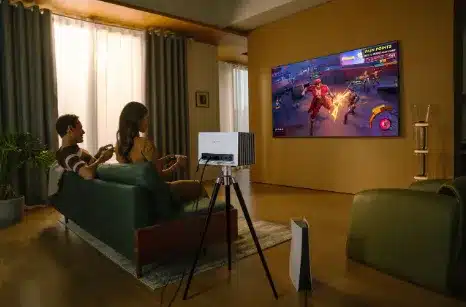
The benefits of this technology extend well beyond passive movie watching. Video games are currently leading the charge in HDR implementation, often featuring color palettes that are more aggressive and saturated than typical live-action films. A serious setup involving a gaming projector benefits immensely from the triple-laser approach.
Modern game engines use physics-based rendering to simulate light interactions. When a player moves from a dark cave into bright sunlight, the shift in dynamic range is drastic. A triple-laser projector handles this transition with speed and precision. The wide color gamut allows fantasy worlds to appear suitably otherworldly, with neon greens and magical purples that standard displays simply cannot reproduce.
Additionally, the stability of the laser light source ensures that these high-contrast images remain consistent over thousands of hours of gameplay. Unlike a lamp that might dim and lose contrast after a few months of heavy gaming, a laser engine provides a consistent HDR experience for years, ensuring that the competitive edge and visual splendor remain intact.
Future-Proofing Your Home Theater Experience
As content creators continue to push the boundaries of visual fidelity, the demands on display hardware will only increase. We are moving toward a future where the BT.2020 color space becomes the norm rather than the exception. Investing in display technology that relies on old filtration methods is a stopgap measure.
Triple-laser technology represents the future of large-format displays. It is the only projection technology currently available that can fully resolve the complex color and brightness data present in modern HDR signals. By eliminating the color wheel and generating light directly, it offers a viewing experience that is not only brighter and more colorful but also more authentic. For the enthusiast seeking to recreate the cinema experience at home, the ability to see a film exactly as it was mastered—with all its dynamic range and color volume intact—is the ultimate goal. RGB laser projection is the key that unlocks that reality.