
Here’s a scenario that plays out in research institutes and international NGOs with frustrating regularity: you’ve recruited a brilliant candidate from abroad. The negotiations centered on a gross salary figure that aligned perfectly with your grant budget and seemed generous. The offer is accepted. Yet, within months, the new hire is in HR’s office, confused and stressed. The paycheck they’re receiving doesn’t match the financial picture they’d mentally painted. The culprit? The vast, un-modelscape between the gross number on their contract and the net amount deposited after US income tax, state deductions, and Social Security.
For institutions operating on the global stage, this isn’t a personal finance issue it’s a strategic talent management failure. We recruit intellect and expertise but often onboard financial anxiety. In a competitive landscape for globally mobile researchers and professionals, providing clarity on net compensation is no longer a courtesy; it’s a fundamental component of a credible, ethical, and effective recruitment package.
The Mandatory Translation: From Budget Line to Livable Income
A grant budget allocates $95,000 for a senior researcher position. This is a clean, accountable line item. But for the researcher relocating from Milan to Miami, or from Nairobi to New York, this figure is meaningless until it’s translated into the currency of daily life: monthly disposable income.
This translation is complex and non-linear. It involves progressive federal tax brackets, fixed FICA contributions, and the wild card of state tax which can range from 0% to over 10%. Offering a gross salary without a transparent, accurate salary estimate of the net result is like providing a map without a scale. It offers direction but no usable sense of distance or terrain.
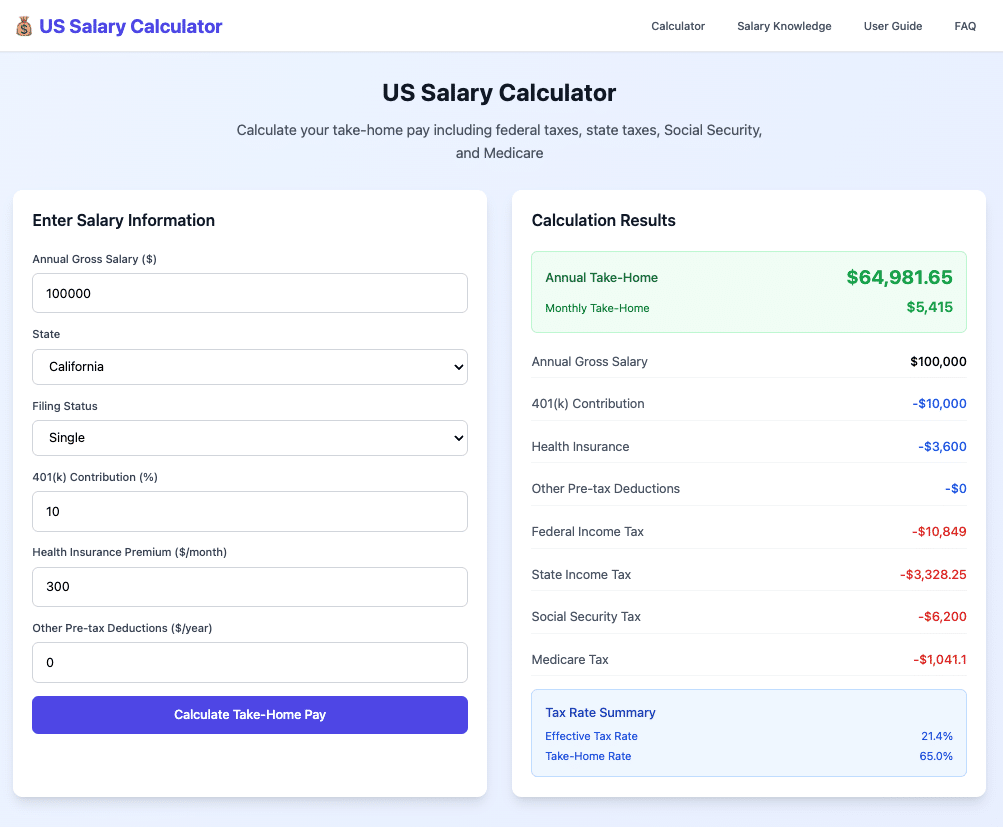
Sophisticated institutions are now integrating this translation directly into their hiring toolkit. They empower candidates (and their own HR teams) with tools that function as financial clarity platforms. These systems do not guess; they calculate. By inputting the gross offer, family status, and precise work location, they generate a reliable forecast of net take-home pay, demystifying the US income tax system and providing a concrete foundation for personal decision-making.
Strategic Advantages of Net Salary Transparency
Moving to a model of net salary transparency yields profound institutional benefits that extend far beyond a smooth onboarding process.
- Builds Trust and Enhances Employer Brand: Proactively providing a detailed net salary estimate signals respect, sophistication, and care. It tells a candidate, “We understand the complexity you’re navigating, and we’re partnering with you to solve it.” This builds immense goodwill and positions the institution as a thoughtful, global employer, crucial for attracting top-tier, discerning talent.
- Mitigates Major Assignment Risk: Financial shock is a leading cause of failed international relocations and early departure. By modeling net income upfront, both the institution and the individual can identify potential shortfalls before they become crises. This allows for proactive solutions a cost-of-living adjustment, a one-time relocation bonus, or simply setting accurate expectations protecting the institution’s significant investment in recruitment and relocation.
- Promotes Internal Equity and Informed Budgeting: When institutions understand the net effect of geography on compensation, they can make more equitable decisions. It allows for data-driven adjustments to ensure a researcher in high-cost, high-tax San Francisco has a comparable quality of life to a peer in lower-cost Raleigh. Furthermore, it leads to more accurate long-term budgeting, as finance officers can model the true cost of talent in different locations.
A Paradigm Shift in Global Compensation
For mission-driven organizations, people are the core asset. Their well-being and focus are directly tied to institutional success. Therefore, the compensation conversation must evolve from a simple exchange of a gross number to a collaborative exploration of net outcomes.
Integrating precise salary estimation tools into the recruitment workflow is a low-cost, high-impact strategic upgrade. It shifts the paradigm from “This is what we pay” to “This is the life this role can support.” In the global competition for expertise, the most powerful offer you can make is one of clarity and confidence. By mastering the net salary equation, you don’t just fill a position; you secure a committed partner, fully equipped to focus on the shared mission from day one.